Mutation/technique illustrated:
Triplet nucleotide amplification detected by Southern blotting and RFLP or by PCR; mutated fragment is larger.
The DNA sequence files are from the Huntington’s disease gene sequence, GenBank accession #L12392, locus HUMHDA, 10,348 bp. To create the Huntington’s mutation, 200 additional CAG repeats were inserted at nucleotide position 363 (the wild type sequence contains 24 repeats). The probe for Southern blot corresponds to nucleotides 4390 to 5160. The sequences had to be modified to work with the PCR primers so the DNA is not interchangeable for Southern blot vs PCR.
To add the bioinformatics activity, the number of CAG repeats was modified so it varied among the individuals with the mutation.
Reference: MacDonald, M. and Ambrose, C.M., Cell 72 (6), 971-983, 1993.
Case A:
Susan is a 23-year-old whose father, age 55, and paternal aunt, age 61, have been diagnosed with Huntington’s chorea. A paternal uncle, age 66, appears to be unaffected by the disease. Susan wants to know if she inherited the mutated gene from her father so that she can prepare for that future if necessary. She arranges to undergo DNA testing for Huntington’s disease. Her 17-year old brother, John, also decides to be tested after talking with Susan.
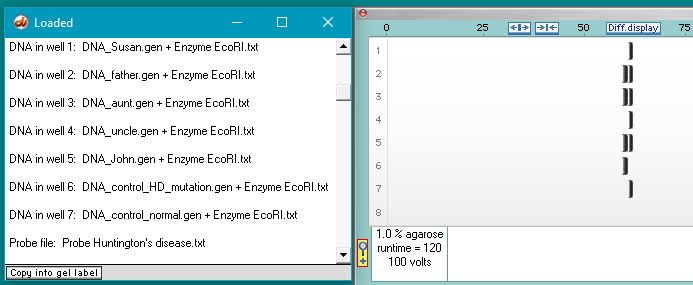
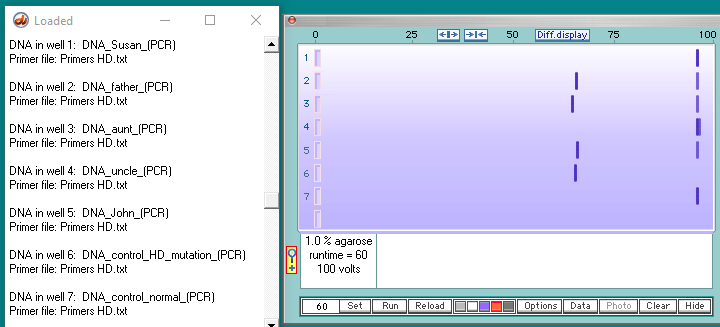
- Susan (patient) – homozygous normal
- Father (affected) – heterozygous (affected)
- Aunt (affected) – heterozygous (affected)
- Uncle (unaffected) – homozygous normal (unaffected)
- John (brother) – heterozygous (affected)
- Control DNA with HD mutation
- Control DNA, normal (without HD mutation)
Issues that could be raised:
- Should someone with a family history of HD be required to undergo testing?
- Should they have children if they test positive, or if they have not been tested?
- Should the results of such tests be made available to insurance companies? to potential employers? to potential mates?
- Should someone as young as John be tested?
- Two bands, very close together, are present for the uncle’s PCR result (lane 4 in second image above). Click on the two bands to see why there is difference between them (you can toggle between ‘size’ and ‘sequence’ by clicking the checkboxes on the gray divider bar). Is this an artifact of the way the files were put together, or could this have biological meaning? If the latter is true, how far apart would these bands have to be before the uncle is no longer considered ‘homozygous normal’? (answer: a band with more than 35 repeats)
Bioinformatics extension
Click here for details of alignment and blasting the sequences from Case A.
Case B:
Josiah and Eldrea were worried about their 52-year-old father. He was starting to act sometimes like this older brother, their uncle Theo. Theo was 15 years older than their father and he had been recently diagnosed with Huntington disease. After speaking with the family physician they learned a diagnostic DNA test was available. They wanted to their father to have the test, and they decided they should take it themselves so that they can better prepare for their future.
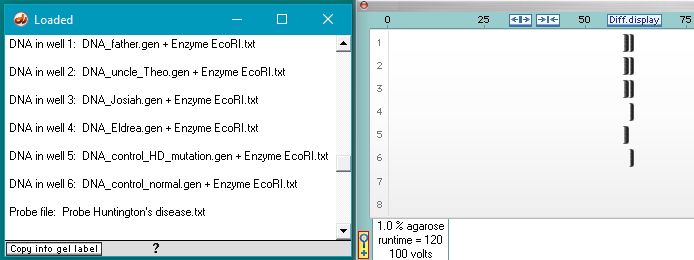
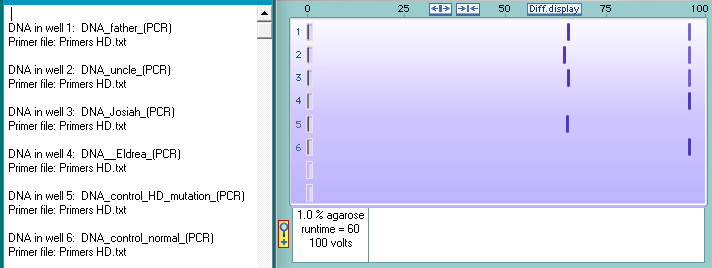
- Father – heterozygous (affected)
- Uncle Theo – heterozygous (affected)
- Josiah – heterozygous (affected)
- Eldrea – homozygous normal (unaffected)
- Control DNA with HD mutation
- Control DNA, normal (with no mutation)
Bioinformatics extension – See Case A for procedure.
Case C:
Forty-four year old Jerry is haunted by the specter of Huntington disease. It took his grandmother, a favorite uncle, and now he sees signs of motor impairment in his 67-year-old mother, Sophie. He worries that he might have inherited the disease and wonders, too, if he may have passed it to any of his 3 children. After several late night family discussions, a date is set for them to provide samples for DNA testing. While he is certain he and his mother should be tested, he wonders if his children are making the right choice.
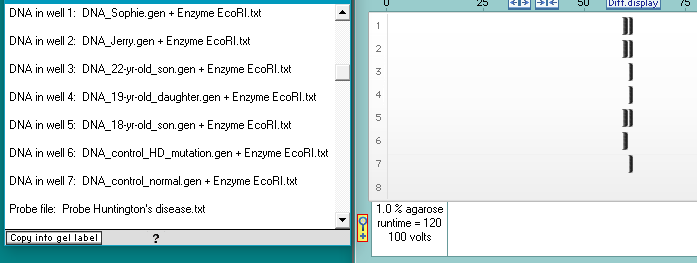
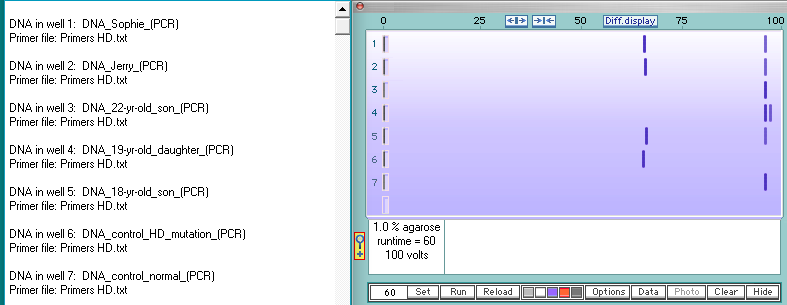
- Sophie (mother) – heterozygous (affected)
- Jerry (father) – heterozygous (affected)
- 22-year-old son – homozygous normal
- 19-year-old daughter – homozygous normal
- 18-year-old son – heterozygous (affected)
- Control DNA with HD mutation
- Control DNA, normal (without HD mutation)
Note: The daughter is homozygous normal but the two bands are close together, similar to the situation for the uncle in Case A. The same kinds of questions could be asked.
Bioinformatics extension – see Case A for procedure